
· by Michael Blair, Nashville's Drainage and Excavation
Nashville sits on rolling ground, and many lots here have a slope at the back or the side. The soil on a lot of those slopes is thin. Barfield, a soil series found in the Nashville Basin, is described in the USDA’s official series description for Barfield as clay over limestone bedrock about 18 inches down, with moderately slow permeability and medium to very rapid runoff. On ground like that, a hard rain runs across the surface instead of soaking in. The longer the slope, the faster it goes: TDEC’s chapter on benching and terracing says steep and long slopes are at greater risk of concentrated flow, and that shortening a slope reduces runoff velocity and erosive power. Concentrated flow is where rills and gullies begin. Fixing it means dealing with the water first and the surface second.
Why does seed alone fail on a slope?
Grass seed on a bare slope has to sprout and root before the next storm, and on any real pitch the runoff often gets there first and carries seed and topsoil to the bottom. The state handbook’s chapter on rolled erosion control products says blankets are used to cut seed loss to wind, runoff and wildlife, and that part of how they help is by reducing soil crusting. A slope that has been reseeded three times and is still bare usually has a water problem, and sometimes a soil one as well. TDEC’s chapter on permanent vegetation names improper pH, missing nutrients and low organic matter as common reasons vegetation struggles, and it recommends a soil test before seeding.
So before anyone talks about seed, we look at what is reaching the slope. When we walk a washed-out bank, we check for a downspout emptying at the top, a driveway or patio shedding onto it, and water coming across the property line from next door. If the roof is part of it, piping the downspouts clear of the slope is usually where we start.
Slow the water first
Water that never crosses the slope cannot cut it. The handbook’s chapter on diversion berms describes berms set above a slope to send runoff away from vulnerable areas, and berms run across an unprotected slope to break up the flow. It also insists that the outlet be protected so the diverted water does no damage where it lands, and it warns that a berm left without vegetation or reinforcement becomes a source of sediment itself. On a house lot we do the same job with a shallow swale or a low berm at the top, seeded and covered, and the water has to end up somewhere lower that can take it; our post on where water should go on a Nashville lot is about finding that spot.
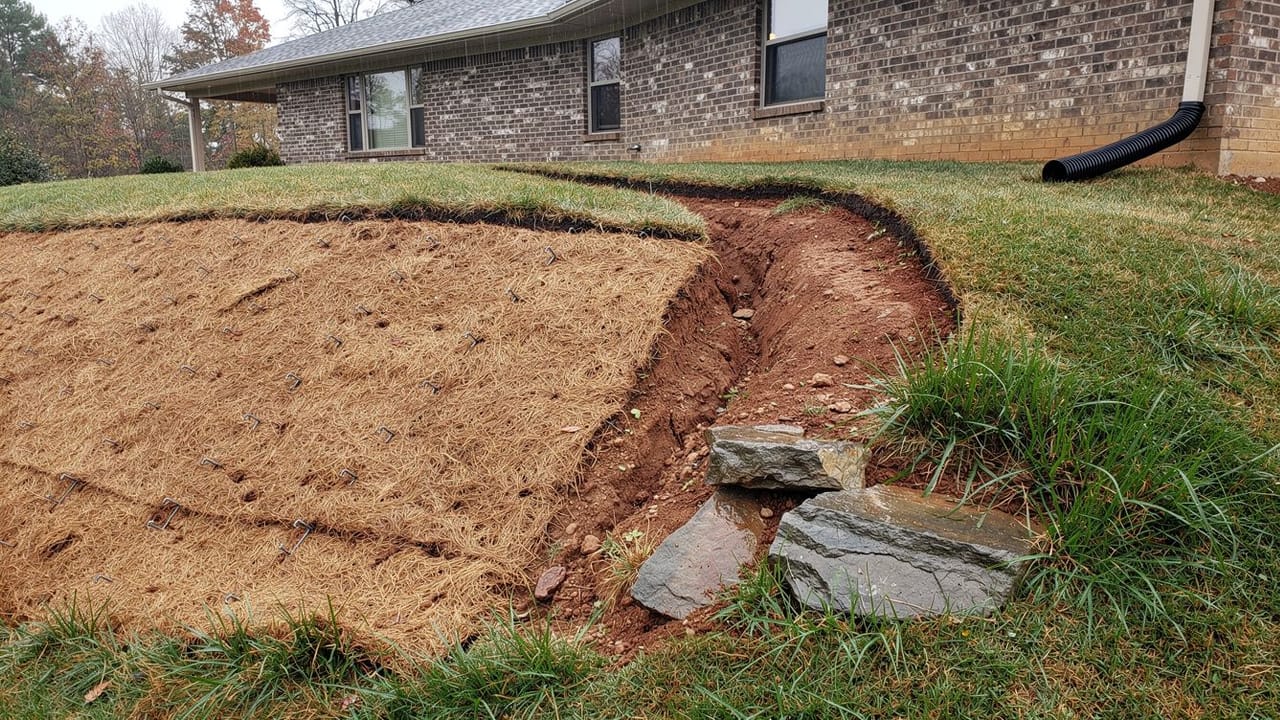
On a long slope, a swale or berm across the grade every so often turns one long run into several short ones. Where a gully already exists, the channel can be lined so water runs there without cutting deeper. TDEC’s chapter on hard armoring covers riprap in channels and swales: it says riprap is best kept to slopes no steeper than 2H:1V, laid on six inches of bedding or over a non-woven geotextile, and that vegetated linings should generally be considered before stone. Filling a gully only works once the water feeding it has gone elsewhere. The blanket chapter makes the same point about its own material, saying that when erosion starts underneath, the drainage issue has to be corrected before anything is put back. When we do fill one, we place the soil in compacted layers and cover it the same day.
- Send downspouts and hard-surface runoff around or past the slope
- Swales or low berms across the grade to break a long run into short ones
- Stone-lined channels, on bedding or fabric, where water has to run
- Fill a gully only after the water feeding it is fixed, then cover the fill
Hold the surface
A seeded slope should be covered. The blanket chapter describes erosion control blankets as temporary covers of natural or polymer fibers held together by biodegradable or photodegradable netting, pinned down to protect bare soil until roots and top growth can take over, and it says they are most effective on slopes of 3H:1V or steeper. The vegetation chapter prefers non-plastic blankets, and the blanket chapter notes that several state transportation departments have adopted netless blankets of wood fiber, coconut coir, cotton or jute that have performed as well as synthetic ones. Hydroseeding sprays seed, mulch and tackifier on as a slurry, but the hydroseeding chapter says typical hydroseeding is mostly effective on flat slopes with mild precipitation, and it does not recommend hydroseed fiber on anything steeper than 4H:1V. Loose straw is the weakest choice of all. The straw and mulch chapter says straw requires anchoring and that mulch alone may not hold through large storms or wind. Blankets need care too, since they can shift in wind and may need extra anchoring where storms are intense.
Choose the cover for the slope. We keep turf to ground a mower can cross safely, and on banks steeper than that we plant groundcovers, native grasses, sedges and shrubs that suit clay. Natives still need looking after. The vegetation chapter calls for watering while plants establish, especially in dry spells and late-season plantings, and for a maintenance plan that covers invasive species control and mowing, though it notes that native species may not need fertilizer. On construction sites it asks for seeding within 14 days of final grading, or within seven days on slopes steeper than 35 percent, and a bare bank behind a house is no less urgent.
When does a slope need terraces or a wall?
Some slopes are too steep to hold with plants, or too close to a house or driveway to be allowed to move at all. The terracing chapter describes terraces as level strips that interrupt and slow the water, best suited to slopes of 3H:1V or steeper, each with a slight backslope and a fall of two to three percent along its length to a stable outlet, and it says these practices should be designed by a professional engineer. It also warns that water soaking in with no drainage outlet can saturate the soil and lead to instability. That is why every wall we set on a slope gets drainage behind it and every step of a terrace gets somewhere to drain, and it is the core of our retaining wall and erosion control work.
Then there are permits. Metro Water Services’ page on who needs a grading permit lists the limits for work that does not need one, among them no more than 100 cubic yards of material, no more than 10,000 square feet of disturbed ground, and bare ground stabilized within 15 days. Grading for landscaping on an existing developed lot is exempt only if the grade changes by 18 inches or less at any point and the drainage path keeps its direction, and exempt work still has to follow Metro’s erosion and sediment control rules. Whether a retaining wall needs a building permit is a question for Metro Codes, so we ask before a wall of any real height goes in. On a slope that is actively failing, the water gets sorted first; if yours is washing out, ask us to come and look at it.
Sources
- USDA NRCS, Official Soil Series Description: Barfield Series — Shallow clay over limestone bedrock at about 18 inches; moderately slow permeability; medium to very rapid runoff
- TDEC, EPSC Handbook 4.3.1 Benching and Terracing (2026) — Concentrated flow on steep slopes; shorter slopes reduce velocity; level strips, backslope, 2 to 3 percent to a stable outlet; engineer design; saturation without drainage outlets
- TDEC, EPSC Handbook 4.2.6.6 Rolled Erosion Control Products (2026) — Blankets reduce seed loss and soil crusting; fiber and netting types; most effective on 3H:1V or steeper; netless natural-fiber blankets; fix drainage before reinstalling; wind displacement; turf reinforcement mats
- TDEC, EPSC Handbook 4.2.6.11 Vegetation and Landscaping: Permanent (2026) — Soil deficiencies and soil testing; non-plastic blankets preferred; watering, maintenance plan, fertilizer for natives; seeding within 14 or 7 days
- TDEC, EPSC Handbook 4.2.1 Diversion Berm or Dike (2026) — Berms above and across slopes; protected outlets; unstabilized berms become a sediment source
- TDEC, EPSC Handbook 4.2.6.4 Hard Armoring (2026) — Riprap in channels and swales; 2H:1V limit; six-inch bedding or non-woven geotextile; vegetated linings considered first
- TDEC, EPSC Handbook 4.2.6.5 Hydroseeding, Soil Binders, and Tackifiers (2026) — Hydroseeding slurry; mostly effective on flat slopes with mild precipitation; fiber not recommended above 4H:1V
- TDEC, EPSC Handbook 4.2.6.9 Stabilization with Straw or Mulch: Temporary (2026) — Straw requires anchoring; mulch alone may not hold in large storms or wind
- Metro Water Services, Who Needs Grading Permit — 100 cubic yards, 10,000 square feet and 15-day stabilization limits; 18-inch landscaping exemption; exempt work still follows erosion control rules
FAQ
Fixing Erosion on a Sloped Nashville Lot — questions
Why does grass seed keep washing off my slope?
Because runoff moves the seed and the topsoil before roots can form. Send whatever is draining onto the slope somewhere else, break long runs with swales or berms, and cover the seeded ground with a pinned erosion control blanket. If it still will not take after that, test the soil, since poor pH and missing nutrients also stop seed from establishing.
What is the best ground cover for a steep bank in Tennessee?
On a bank too steep to mow safely, we plant native grasses, sedges, spreading shrubs and groundcovers that suit clay. They need watering while they establish and some upkeep afterward, though natives may not need fertilizer. On a slope of about one foot of rise for every three feet across, or steeper, plant them into an erosion control blanket so the surface holds while they root; very long or very steep slopes can call for a heavier permanent turf reinforcement mat.
How do I fix a gully in my yard?
Stop the water that is feeding it first, usually a downspout or runoff from a hard surface. Then either line the channel with stone over a bedding layer or fabric so water can run there without cutting, or fill it in compacted layers and cover the fill with blanket and planting straight away. Filling it without fixing the water means it comes back, and a large fill can need a grading permit from Metro Water Services.
How does slope affect erosion?
Steeper and longer slopes wash out faster. Tennessee’s erosion control handbook says they carry a greater risk of concentrated flow, which is where rills and gullies start, and that shortening a slope cuts the speed and cutting power of its runoff. That is why a swale or berm across a long bank helps it hold.