
· by Michael Blair, Nashville's Drainage and Excavation
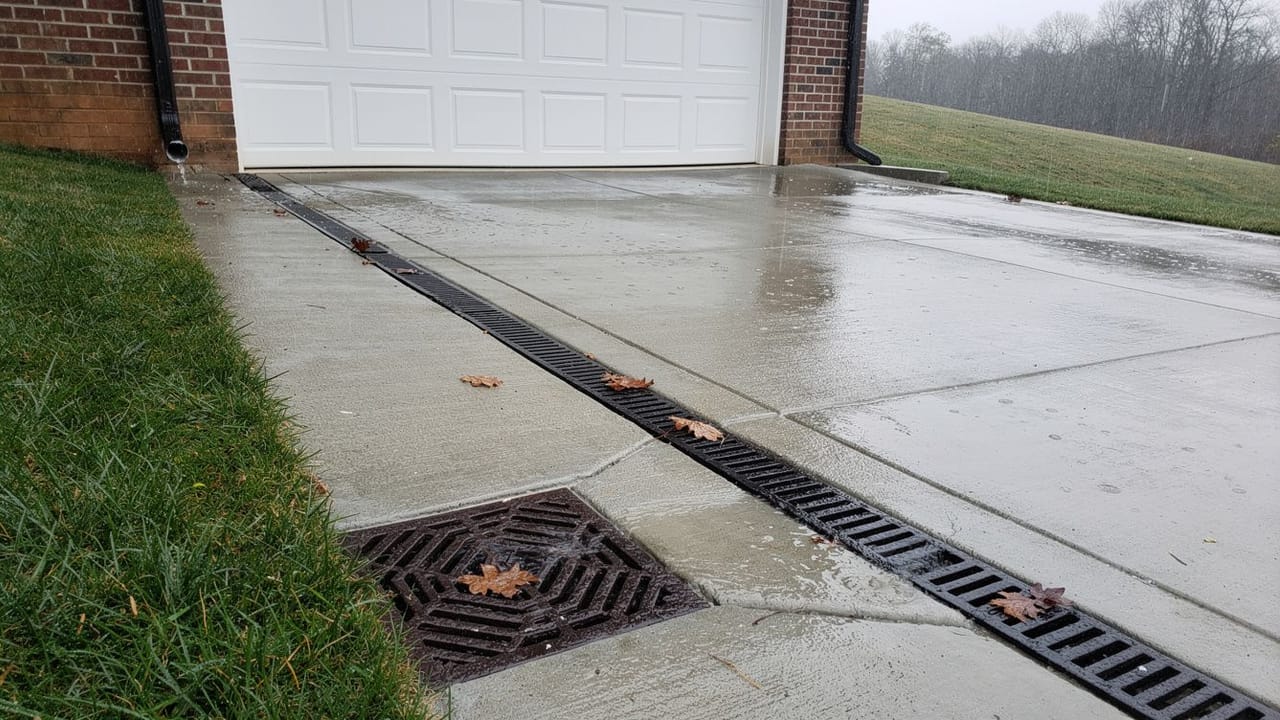
Some Nashville driveways slope the wrong way. On some lots the drive falls toward the house instead of the street, and where a hillside garage sits below the road the driveway is a ramp that delivers rain straight to the garage door. The water either comes under the door, pools against the foundation, or both. The 2024 International Residential Code, which Metro lists on its adopted codes page, asks for paved surfaces within 10 feet of a house to slope at least 2 percent away from it, and where lot lines, walls or slopes keep the ground from falling away it calls for drains or swales instead. When regrading the drive isn’t practical, that drain is usually a channel drain, sometimes called a trench drain, across the driveway in front of the garage, with a catch basin where water gathers at one spot and pipe carrying it all somewhere it can go.
What does a channel drain do?
A channel drain is a long, narrow trough set into the paving, with a grate on top, that intercepts sheet flow across its whole length. It goes where water crosses a line: at the garage door, at the bottom of a sloped driveway, along a patio edge. A catch basin is a box with a grate that collects water at a single low point: where two slopes meet, at the end of a swale, or where a downspout and surface water both arrive. Many driveways need both: a channel at the door and a basin at the low corner.
We run the channel edge to edge across the flow, so water reaching the end of it has no way around to the door. The grate and channel also have to suit what drives over them. Trench drain makers rate their systems by load class, and Sioux Chief’s installation guide for its FastTrack trench drain thickens the concrete around the channel as the class goes up, from 4 inches for Class A to 10 inches for Classes E and F. We don’t put a light patio grate where a car turns into the garage.
Where the water goes afterward
The drain is only as good as its outlet; a channel with nowhere to send the water fills and spills back toward the door. Metro’s Stormwater Management Manual names the ways runoff may leave: back into the channel at natural elevations, into an existing facility with room to take it, or into an approved drainage well, and any change or addition to Metro’s stormwater system needs Metro Water Services’ approval. On a house lot that usually means pipe with continuous fall to daylight on a slope below the house, or a connection Metro has signed off on. A dry well is the last thing we look at. Metro’s design sheet for infiltration trenches wants soil that takes in at least half an inch of water an hour and rules them out on clay or silt soils and karst, and the USDA’s description of Bradyville soils, found in the inner Nashville Basin, gives them a clayey subsoil, moderately slow permeability and limestone sinks in the uplands around them. More on that in our post on dry wells and Nashville clay.
From the drain we run solid pipe, not perforated, sized for the flow, with cleanouts where it turns. Sending the water onto a neighbor’s lot is off the table. The same manual says a design must not adversely affect neighboring properties, Metro’s grading permit page says a permit gives no right to discharge onto adjacent property without that owner’s consent, and Metro Water Services does not step in on runoff passing from one private lot to another.
- A channel across the full width of the flow, with a grate rated for vehicles
- Solid pipe with continuous fall to daylight or an outlet Metro has approved
- A catch basin deep enough to hold sediment below the pipe
- Cleanouts, and grates that lift out for cleaning
How is a channel drain added to an existing driveway?
In an existing concrete driveway we saw-cut a slot across the drive, break out the concrete and set the channel in new concrete. Sioux Chief’s guide calls for full concrete encasement on three sides whatever the surface finish, expansion joints on both sides of the channel, and work that starts at the outlet and moves upstream. It puts the finished grate about 3/16 inch below the slab, with the slab sloping into the channel from both sides, so water drops in rather than skipping over. Its drawing shows asphalt laid over the concrete encasement, so a channel in an asphalt drive still sits in concrete. In pavers we set the channel before the pavers go down, or lift a row to fit it.
Most of what goes wrong happens in the setting. The same guide calls for a frost-proof, load-bearing base under the encasement and for the grate to stay in the channel while the concrete sets, so the channel keeps its shape. We check the grate height against the slab and the fall of the run toward its outlet before any concrete goes in, and we follow the maker’s sheet for whichever channel is going in.
Keeping it working
Leaves and grit wash into the channel, and a drain nobody cleans clogs at the outlet and quits when it is needed most. Metro Water Services’ stormwater maintenance page asks owners to keep drainage clear of trash and debris, because a blocked ditch or culvert raises the chance of flooding, and it leaves drainage on private property to the owner. We suggest lifting the grates and clearing the trough after the fall leaf drop and whenever water stands in it. The catch basin holds sediment on purpose, and the EPA’s stormwater maintenance page counts sediment removal as routine catch basin upkeep, so it gets scooped out too. If the flow slows, flush the pipe from the cleanout.
A driveway drain also does nothing for water running down the edges of the drive or a downspout emptying beside the garage. Metro’s maintenance page says to turn downspouts away from paved surfaces toward ground where the water can soak in, and the code’s slope rule covers the yard as much as the drive. We take those on with regrading and downspout drainage at the same time, or the drain handles the driveway and the wall next to it still gets wet. If water is reaching your garage door, ask us for a free estimate.
Sources
- ICC, 2024 International Residential Code, R401.3 Drainage — Paved surfaces within 10 feet of the foundation slope at least 2 percent away; drains or swales where barriers prevent the grade falling away
- Metro Nashville Codes, Adopted Codes List — Metro has adopted the 2024 International Residential Code
- Sioux Chief, FastTrack Large-Capacity Trench Drain Installation Guide — Encasement thickness by load class; full encasement on three sides; expansion joints; start at the outlet; grate about 3/16 inch below the slab; asphalt over encasement; frost-proof base; grate in place during the pour
- Metro Water Services, Stormwater Management Manual Vol. 1, Chapter 6 (2026) — Permitted outlets including an approved drainage well; changes to the Metro system need MWS approval; no adverse effect on neighboring properties
- Metro Water Services, SWMM Vol. 4 PTP-14 Infiltration Trenches (2009) — Infiltration of 0.5 in/hr or more required; not for clay or silt soils; not in karst
- USDA NRCS, Official Series Description: Bradyville — Inner Nashville Basin; clayey residuum of limestone; moderately slow permeability; limestone sinks
- Metro Water Services, Who Needs A Grading Permit — A permit gives no right to discharge onto adjacent property without the owner’s consent
- Metro Water Services, Stormwater Maintenance — Keep conveyances clear of debris; owners maintain private drainage; Metro does not handle private-to-private runoff; redirect downspouts to ground that absorbs water
- US EPA, NPDES Stormwater Maintenance — Catch basin maintenance includes trash and sediment removal
FAQ
Channel Drains and Catch Basins for a Driveway — questions
How do I stop water coming under my garage door?
Where the driveway can’t be regraded to fall away from the garage, a channel drain across it just outside the door, spanning the full width of the flow and piped with continuous fall to a working outlet, catches the water before it reaches the door. Downspouts and edge water feeding the drive get fixed at the same time, or they keep sending water to the same spot.
Can a channel drain be added to an existing concrete driveway?
Yes. A slot is saw-cut across the driveway and the channel set in new concrete that surrounds it, with expansion joints alongside. One manufacturer’s guide puts the grate about 3/16 inch below the slab, with the slab sloping into it from both sides. The parts that decide whether it works are that height, the fall along the run and the pipe to a working outlet.
Where should a driveway drain discharge?
To daylight on a slope below the house, or into Metro’s storm system only with Metro Water Services’ approval. A dry well needs soil that takes in water quickly: Metro’s own standard for infiltration trenches asks for at least half an inch an hour and rules them out on clay soils, so the soil gets tested first. Not onto a neighbor’s property, since a Metro grading permit gives no right to discharge there without the owner’s consent. A drain with no real outlet backs up in the first heavy rain.
How often should a driveway drain be cleaned?
After the fall leaf drop each year, and again any time water stands in the trough. Lift the grates and clear out the leaves and grit, scoop the sediment out of the catch basin, which is built to hold it, and flush the pipe from its cleanout if the water seems slow to leave.